Posted on
December 4, 2023
by
Marie Taverna
REAL VS. FAKE CHRISTMAS TREES: WHICH IS BETTER?
By Meaghan Weeden
We spend a lot of time talking about the benefits of trees and why you shouldn’t cut down trees, but you may be wondering, what about about Christmas trees? Are Christmas trees eco-friendly? Are real Christmas trees better for the environment? Or is it better to purchase a fake Christmas tree to save the real trees from being cut down?
We’re here to alleviate these concerns for all Christmas-loving environmentalists by answering this question and more. And if you want to further reduce your environmental impact this holiday season, you can also check out our tips for a sustainable holiday!
ARE FAKE CHRISTMAS TREES BAD FOR THE ENVIRONMENT?
Artificial trees can last many years if well cared for, which seems to make them the obvious sustainable choice, but they do have drawbacks. Because most are made with plastic and metal materials, they take a lot of resources to create — and their plastic components will exist for thousands of years, polluting our oceans and filling the bellies of sea turtles.
Often produced and shipped from China, they also have a hefty carbon footprint— to the tune of up to 88lbs of CO2 per artificial tree, which is over 10X higher than that of a sustainably grown, properly recycled real Christmas tree.
In fact, you would have to keep your fake Christmas tree for at least 10 years for it to have the same carbon impact as using a real tree each year — and that isn’t considering the environmental damage artificial trees cause as they slowly break down in a landfill. And let's be real: the likelihood of them staying nice enough to keep for 10 years is low.
ARE REAL CHRISTMAS TREES BETTER FOR THE ENVIRONMENT?
Yes, real Christmas trees are more eco-friendly and a better choice for the environment. It may feel counter-intuitive, but it's much more sustainable to cut down a real tree each year. That’s because most small-scale Christmas tree farms are inherently sustainable, leaving certain sections open for harvesting every year, while keeping other areas roped off to give younger trees a chance to grow.
It takes around 7 years to grow an average-sized Christmas tree, and as trees grow, they absorb carbon and use 10x fewer resources than artificial tree factories. According to the Association of Christmas Tree Growers, for every tree that is cut down each year, 1 to 3 new seedling trees are planted.
This rotating cycle ensures that the farmers will have a steady harvest of salable trees every year, but it also provides habitat for wildlife and protects the land from getting used for other purposes. In fact, many Christmas tree growers utilize steep hillsides that would otherwise be unsuitable for agricultural activities.
In short: sustainable Christmas tree farms are both the ethical andsustainable choice: they can be great for the environment and for the people who work and live on them, for whom jobs and income are generated. And of course, unlike fake trees, real trees are completely biodegradable and can be used for lumber, turned into mulch, donated to restoration projects, composted and used to fertilize next year’s crop, fed to goats (check with your grower to ensure no chemicals were used), and more!
DO ALL REAL CHRISTMAS TREES HAVE THE SAME ENVIRONMENTAL IMPACT?
Unfortunately, there are bad actors out there that cut trees from primary forests, which means that not at all real Christmas trees have the same environmental impact. But if you’re willing to spend a little time researching, you likely can find a small tree farm near you where you’ll be able to see exactly where and how the trees are grown and managed.
Real Christmas trees, like any houseplant, help clean the air inside your home by removing dust and pollen particles. So you’ll also be improving your indoor air quality, which often declines after homes are sealed up for winter.
Of course, you could also go full-on hippie and find a sustainable alternative Christmas tree, or get a live tree that can then be planted outdoors after the holidays (just make sure it’s a native tree species suited to your climate). You could even bedazzle that massive monstera in your living room. We won't judge!
HOW TO RECYCLE YOUR REAL CHRISTMAS TREE
Once the holiday season is over, there are plenty of options for properly disposing of your Christmas tree:
- Participate in a local tree recycling program if there's one in your area
- If you have a wood chipper, chip the tree for free mulch
- Donate it to a local environmental organization, who may repurpose it for restoration projects like beefing up riparian areas, protecting fragile dunes, sheltering wildlife and more.
- Use the needles for crafts like evergreen potpourri, the trunk for natural coasters and more!
- Strip the tree bare and use it to build a frame for vine-y garden plants like beans, cucumbers and flowers.
- Donate it to a local goat farm (as long as it has not been sprayed with harmful pesticides or other chemicals) — look up goats eating Christmas trees videos and you'll see why this is such a fun option.
- Secure the tree outside in a spot that's sheltered from wind to provide a winter shelter for small mammals and more!
And finally, if you’re still concerned about your holiday impact, consider planting a tree with us to offset your Christmas tree!
Posted on
December 4, 2023
by
Marie Taverna
On the coldest winter days, nothing beats getting cozy next to a warm, crackling fireplace. Like any major appliance in your home, a fireplace – whether gas or wood-burning – needs seasonal maintenance to prepare it for frequent usage when outside temperatures drop.
Here’s how you can prepare your home’s fireplace for the upcoming winter months:
If you have a wood-burning fireplace:
- Inspect your chimney inside and out for damage. Look for any cracks, crumbling mortar or signs of deterioration that could hamper your chimney’s structural integrity.
- Get a professional chimney sweep to clear out any built-up soot or debris. Doing this at least once per year can help prevent chimney fires.
- Install a chimney cap to keep out any critters. By installing a chimney cap, wildlife, rain and tree debris will have a harder time traveling into your fireplace.
- Trim trees and overhanging branches around your chimney. This will help to prevent fires, as well as any damage to your chimney cap from falling tree limbs.
- Check the mechanical parts of your fireplace to ensure that they are working properly. This includes the damper, the mechanism that controls air flow to the chimney, and the blower, which pushes heat from the fireplace into the room. Be sure to also inspect your fireplace’s gasket to confirm that there is no smoke escaping into your living space.
- If you’re clearing out piles of ash from the bottom of your fireplace, don’t be tempted to use your vacuum cleaner. This can damage your appliance and send ash shooting into the air. Instead, scoop out the ash by hand with a small shovel and dispose of it in the compost bin.
If you have a gas fireplace:
- Schedule an inspection with a professional technician to do a thorough examination of your fireplace before the first use of the season.
- Inspect the pilot light to confirm that it is switched on and that you have a good connection to your gas feed. If you are reopening your gas line and relighting your pilot for the first time this season, monitor your pilot light during the first use to ensure that it functions as normal.
- Read your manufacturer’s manual to review the operation of your fireplace. It never hurts to refresh your knowledge of the mechanics and functions of your fireplace before you use it for another season.
Regardless of the type of fireplace in your home, you should always clean and dust your unit regularly and especially before the first use of the season. This is also a great time to test your home’s smoke alarms and carbon monoxide detectors.
Posted on
December 4, 2023
by
Marie Taverna
A lush lawn and blooming flower beds are the pride and joy of many homeowners. Canada’s harsh winters, however, can quickly squash the hard work you’ve put into nurturing and maintaining your outdoor spaces during the summer months. To ensure that your backyard gets off to a good start when spring arrives, a little prep work before the snow hits can do a world of good.
Help prepare your lawn and garden for colder weather this year by following these winterization tips.
Care for your annuals and perennials
When it comes to winterizing your garden beds, show your plants and flowers some love. Start by removing any annuals (plants that are only around for one growing season, such as sunflowers, tomatoes and varieties of lettuce). Removing annuals will rid your beds of lingering bacteria, and prevent any potential pests or diseases from building up during the winter.
For your perennial plants, give them a healthy trim back and a final water before the end of the season. Perennials with large and dense roots can be cut and divided into smaller plants to support better regrowth in the spring.
Bring delicate plants, such as succulents or potted bulbs, indoors to prevent frost damage. Cover any shrubs or plants that can’t be moved inside with landscape fabric or burlap to protect them from harsh weather conditions.
Get down in the dirt
Just like your plants, your soil also needs some help preparing for the winter ahead. Remove any weeds, dead plant debris and buried root vegetables from your soil before the first hard frost sets in. Spread mulch over your soil and around the base of trees to provide a protective layer from frost and a barrier that will help to keep moisture and temperature levels consistent for your plants. When cleaning up your soil, you may also want to consider planting bulbs for the following spring, such as crocus, tulips and daffodils.
Show your lawn a little TLC
The ground gets compacted and cold during the winter, which can make it difficult for lawns to recover post-thaw. Help your lawn out by aerating it in the fall to loosen soil and ensure better drainage. Instead of raking all of the tree leaves off of your lawn, cut your grass long — approximately two to three inches high — and leave a layer of shredded leaves on top. Mowing the leaves into tiny pieces will allow your lawn’s soil to absorb nutrients from the fallen debris more efficiently while still letting light and moisture through. In low-traffic areas where your lawn is patchy and damaged, overseed in the early fall for best results in the spring.
Add a boost of nutrients
As your garden prepares for hibernation, it helps to give your outdoor greens some needed nourishment.
If you have a compost bin, sprinkle this material on your flower beds to help them replenish their nutrients post-winter, and top up your bin with any leaves, grass clippings or debris from your winterization clean up. You can give your lawn a final dose of sustenance too with the help of special winter grass fertilizer that contains nitrogen and potash.
Not all of your fallen leaves have to end up in paper bags. Instead, add mulched leaves to your perennial flower beds and vegetable gardens as an insulating layer and a source of valuable nutrients for the soil.
Posted on
December 4, 2023
by
Marie Taverna
Despite softening activity, Canada’s winter recreational property market is expected to see price gains in 2024
Nationally, median house price forecast to rise 2.9% in 2024 as interest rates are expected to stabilize or moderate
Activity in Canada’s winter recreational home markets has cooled from pandemic-era highs with fewer buyers putting pen to paper and inventory levels rising modestly, amid concerns over rising interest rates and the higher cost of living. With borrowing rates widely expected to remain stable or dip slightly next year, property prices for homes in Canada’s sought-after winter playgrounds are expected to rise marginally.
According to the Royal LePage 2023 Winter Recreational Property Report, the median price of a single-family detached home in Canada’s recreational ski regions will increase 2.9% over the next 12 months to $1,099,661. This forecast is based on the expectation of stable interest rates through 2024 or a modest decline.
“Recreational house prices in Canada’s popular ski regions are expected to remain stable in the year ahead. While demand has weakened and supply has increased compared to the pandemic-fueled boom, market activity is trending back to normal historical levels,” said Pauline Aunger, broker of record, Royal LePage Advantage Real Estate. “This will keep prices on a modest upward trajectory in the coming year as Canadians continue to seek out a spot on some of the world’s most desirable slopes.”
Home prices in Canada’s popular ski regions posted a modest year-over-year decline since the beginning of 2023 as buyer demand continues to soften. This softening is largely due to high interest rates and the rising cost of living as well as a general uneasiness about the state of the economy, the report found. Nationally, in the first 10 months of 2023, the median price of a single-family detached home remained essentially flat, decreasing 0.7% year over year to $1,068,200.
“Although recreational real estate markets vary greatly from one region to the next, activity on the whole in Canada’s winter recreational communities has noticeably slowed. Annual sales are down in most regions and inventory has climbed modestly as the market continues to regain balance. This has not, however, translated to steep price declines in a majority of markets. While the rising cost of living has had an impact on demand for recreational real estate, prices have remained stable due to relatively low supply and sellers’ capacity to hold out for a desirable deal,” said Aunger. “Market activity is trending back to historical norms, following an unprecedented boost in activity during the pandemic. In addition to a return to normal work and social routines, today’s elevated interest rate environment has exacerbated this cooldown, as consumers are more concerned about mortgage expenses and the overall economy, including those shopping in high-end recreational markets.”
Read Royal LePage’s 2023 Winter Recreational Property Report for national and regional insights.
Highlights from the national release:
- 24% of Royal LePage recreational property market experts reported a decline in buyer demand this year as a result of climate factors or environmental disasters, following unprecedented wildfire season
- 41% of experts reported an increase in inventory as a direct result of rising interest rates
- Quebec’s Mont Sutton and B.C.’s Mount Washington/Comox Valley regions recorded highest median price gain in single-family detached segment, increasing 27.3% and 26.5% respectively, year over year
- Mont Sainte-Anne in Quebec recorded an 83.4% increase in year-over-year median condominium price; sharp gains reflect wide range in property styles and price points, and scarcity of inventory
Posted on
December 4, 2023
by
Marie Taverna
Federal Government pledges more funding for affordable housing
What does it mean for the average Canadian?
On November 21st, the Government of Canada unveiled its 2023 Fall Economic Statement, an annual fiscal report that provides an update on the state of the Canadian economy and the government’s plans for future spending. The report – acutely focused on Canada’s housing affordability and supply crisis – announced new funding for the creation of more affordable housing and purpose-built rental units. New rules regarding the mortgage stress test were also unveiled.
For Canadians planning to buy a home or rent a property in the near future, these initiatives will lead to the creation of some much-needed housing supply in some of the country’s most expensive regions.
Here’s what you need to know about housing initiatives announced in the 2023 Fall Economic Statement:
The Canadian Mortgage Charter – Since interest rates started to rise in March 2022, many variable-rate mortgage holders have faced fast-rising monthly payments and, in some cases, negative amortization as interest payments outpace their mortgage principal. Thousands of Canadians will also be required to renew their mortgage at a much higher interest rate in the next two years compared to the ultra-low rates offered during and just prior to the pandemic. In light of these financial challenges, the federal government has put forward new measures for financial institutions to provide Canadian borrowers with mortgage relief options.
The Charter includes:
- Permitting temporary extensions of mortgage amortizations
- Waiving fees that would have previously applied for relief measures
- Dropping the requirement for insured mortgage holders to requalify under the insured minimum qualifying rate (stress test) when switching lenders at the time of their mortgage renewal
- Requiring lenders to contact homeowners four to six months prior to their mortgage renewal to inform them of their financial options
- Giving homeowners at risk the ability to make lump sum payments to avoid negative amortization, or sell their principal residence without any prepayment penalties
- Waiving interest on interest in the event that mortgage relief measures result in a temporary period of negative amortization
New funds for affordable housing – In an effort to build more homes faster, the federal government has pledged billions of dollars in spending towards the creation of affordable and purpose-built rental housing. An additional $1 billion will be allocated over three years to non-profit, co-op, and public housing providers through the Affordable Housing Fund to build more than 7,000 new homes by 2028. The Co-operative Housing Development Program will also receive nearly $310 million in new funding.
Incentives for apartment builders – To encourage the creation of much-needed rental housing, the 2023 Fall Economic Statement outlines new funding for home builders. Starting in 2025-2026, the federal government says it has committed an additional $15 billion in funding for the Apartment Construction Loan Program, which provides low-cost financing to builders and developers. This top-up will support the creation of more than 30,000 additional new homes across Canada, bringing the government’s total goal to 101,000 new homes by 2031-2032.
Tax limitations on short-term rentals – With the demand for long-term housing options so high across Canada, the federal government is placing stricter measures on short-term rentals in the hopes of encouraging property owners to list their homes for sale or for longer leasing periods. The 2023 Fall Economic Statement introduced $50 million in funding over three years to support municipal enforcement of restrictions on short-term rentals. Additionally, income tax deductions for expenses incurred on short-term rental income will be denied in provinces and municipalities that have banned short-term rentals. This will also apply to short-term rental operators who are not compliant with provincial or municipal licensing, permitting, or registration requirements.
Want to know more about the 2023 Fall Economic Statement? Read the full report here.
Posted on
December 4, 2023
by
Marie Taverna
Balanced conditions come to the Metro Vancouver housing market for the holiday season
With one month left in 2023, a steady increase in housing inventory is offering home buyers across Metro Vancouver1 among the largest selection to choose from since 2021.
The Real Estate Board of Greater Vancouver (REBGV) reports that residential sales2 in the region totalled 1,702 in November 2023, a 4.7 per cent increase from the 1,625 sales recorded in November 2022. This was 33 per cent below the 10-year seasonal average (2,538).
“We’ve been watching the number of active listings in our market increase over the past few months, which is giving buyers more to choose from than they’ve been used to seeing over the past few years,” Andrew Lis, REBGV’s director of economics and data analytics said. “When paired with the seasonal slowdown in sales we typically see this time of year, this increase in supply is creating balanced conditions across Metro Vancouver’s housing market.”
There were 3,369 detached, attached and apartment properties newly listed for sale on the Multiple Listing Service® (MLS®) in Metro Vancouver in November 2023. This represents a 9.8 per cent increase compared to the 3,069 properties listed in November 2022. This was 2.8 per cent below the 10-year seasonal average (3,464).
The total number of properties currently listed for sale on the MLS® system in Metro Vancouver is 10,931, a 13.5 per cent increase compared to November 2022 (9,633). This is 3.7 per cent above the 10-year seasonal average (10,543).
Across all detached, attached and apartment property types, the sales-to-active listings ratio for November 2023 is 16.3 per cent. By property type, the ratio is 12.7 per cent for detached homes, 19.8 per cent for attached, and 18.2 per cent for apartments.
Analysis of the historical data suggests downward pressure on home prices occurs when the ratio dips below 12 per cent for a sustained period, while home prices often experience upward pressure when it surpasses 20 per cent over several months.
“Balanced market conditions typically come with flatter price trends, and that’s what we’ve seen in the market since the summer months. These trends follow a period where prices rose over seven per cent earlier in the year,” Lis said. “You probably won’t find Cyber Monday discounts, but prices have edged lower by a few per cent since the summer. And with most economists expecting mortgage rates to fall modestly in 2024, market conditions for buyers are arguably the most favorable we’ve seen in some time in our market.”
The MLS® Home Price Index composite benchmark price for all residential properties in Metro Vancouver is currently $1,185,100. This represents a 4.9 per cent increase over November 2022 and a one per cent decrease compared to October 2023.
Sales of detached homes in November 2023 reached 523, a seven per cent increase from the 489 detached sales recorded in November 2022. The benchmark price for a detached home is $1,982,600. This represents a 6.8 per cent increase from November 2022 and a 0.9 per cent decrease compared to October 2023.
Sales of apartment homes reached 850 in November 2023, a 0.4 per cent increase compared to the 847 sales in November 2022. The benchmark price of an apartment home is $762,700. This represents a 6.2 per cent increase from November 2022 and a one per cent decrease compared to October 2023.
Attached home sales in November 2023 totalled 316, a 12.5 per cent increase compared to the 281 sales in November 2022. The benchmark price of a townhouse3 is $1,092,600. This represents a 6.9 per cent increase from November 2022 and a 0.7 per cent decrease compared to October 2023.
Download the November 2023 stats package.
Posted on
November 5, 2023
by
Marie Taverna
Crafting a colourful space you’ll love for years to come
Crafting a colourful space you’ll love for years to come
 GlucksteinHome Monroe sofa, Zana coffee table, Monroe nesting tables, Monroe area rug
If you know Brian Gluckstein, you know that he’s renowned for his timeless neutral interiors. But the designer is also an expert at using colour to create a thoughtfully designed, trend-proof space. In this stylish living room, we see colours take centre stage in a beautifully balanced way. It’s a happy space that’s decorated with colour and a room we can see ourselves living in for years to come.
So how exactly did Brian create this fresh and colourful yet liveable space? We’re sharing a few of his tips to incorporate colour into your space like a pro:
1. START WITH THE ART AND RUG
Starting with larger pieces like the art and rug can help you lay the groundwork for decorating the rest of the room. Draw on coordinating colours from these pieces to help you determine upholstery and paint finishes for a balanced, well-crafted space.
2. CREATE A MOODBOARD OF WHAT YOU LIKE
Start a Pinterest board or Saved collection folder on Instagram of colourful rooms you love. This will allow you to organize your thoughts and give you a clearer vision for the design of the room. Reflecting on what you’ve collected and identifying common themes in your saves will be a helpful indicator of what you really want.
3. TAKE NOTE OF YOUR SURROUNDINGS
When choosing colours to decorate a room, it’s important to take note of the surrounding exterior. Is there a red brick building that will cast warm hues through your window or plenty of trees that will add coolness? Even for the most confident of designers, it’s a good idea to buy tester pots of paint to see how it reads in the room before investing plenty of time and money.
4. COLLECT MATERIAL SAMPLES
Think of them as tester pots for fabric. Collect swatches of upholstery, drapery, and cushion options to test with one another and make sure your finishes coordinate with each other as well as connect back to larger pieces like the area rug and artwork.
5. THINK ABOUT THE LIGHTING
Particularly when decorating with colour, the colour of your light bulb can affect how colour looks in the space. We typically want warmer bulbs in spaces where we’re going to spend time relaxing, like the living room or bedroom, whereas cooler lights improve focus in working areas like an office or kitchen. Test out your lighting against fabrics and paint to make sure you’re happy with the final result.
Photography courtesy of Hudson’s Bay
Posted on
November 5, 2023
by
Marie Taverna
 GlucksteinElements Windermere pendant lights; GlucksteinHome Quincy dinnerware, Milano serveware GlucksteinElements Windermere pendant lights; GlucksteinHome Quincy dinnerware, Milano serveware
Your kitchen is the heart of your home, where delicious meals are prepared, memories are made, and conversations flow. Over time, your kitchen might start to look a bit dated, but you don’t need a complete renovation, or substantial investment, to breathe new life into this vital space. With some budget-conscious ideas, you can create a kitchen that’s both functional and stylish, tailored to your specific taste. Read on for affordable, easy updates that will transform your kitchen into a space that’s both contemporary and welcoming.
1. REFRESH YOUR CABINETS WITH PAINT
If you have well-maintained wooden cabinets that feel a bit outdated, a fresh coat of paint can work wonders. Opt for classic white or neutral hues for a timeless look. Alternatively, introduce a touch of personal style with bolder colour choices like deep blues or rich greens, creating a stylish statement without the need for cabinet replacements.
2. ELEVATE YOUR HARDWARE
Upgrading your cabinet hardware is a subtle yet impactful way to update your kitchen’s aesthetic. Replace standard knobs and pulls with more elevated options, like sleek, modern handles or transitional designs. Select finishes like black, nickel, chrome, or brass to maintain a timeless appeal, and don’t hesitate to mix metals throughout your space for an eclectic touch.
Brian’s Tip: For a quick and easy kitchen refresh with big impact, change your cabinet hardware to matte black and swap in a new faucet to match.
3. PERSONALIZE YOUR BACKSPLASH
Beyond its functional role, the backsplash serves as a canvas for personal expression. A simple, white subway tile can lend a modern touch to your kitchen. However, if you’re inclined to make a statement, explore mosaic or glass tile options to introduce a more dramatic moment.
4. INVEST IN YOUR COUNTERTOP
Consider upgrading your countertop material, especially if you’re currently working with laminate. Stone or quartz countertops not only enhance the aesthetic appeal but also elevate the functionality of your kitchen, giving it a luxurious and contemporary feel.
5. FLOORING CHOICES
If you have an older ceramic tile floor, consider updating it or replacing it with wood for a warm and inviting feel. For a more affordable and easy kitchen update, add a runner rug. It not only adds character and style, but a welcoming and cozy texture to your kitchen. Plus, in an open-concept home, a runner can help define the kitchen area.
6. ILLUMINATE WITH PURPOSE
Enhance your kitchen’s lighting to optimize both functionality and style. Consider adding pendant lights above your kitchen island, transforming it into a focal point that makes a style statement. Choose a light in a design that matches your kitchen’s aesthetic, whether sleek and modern, classic, or eclectic.
Consider adding under-cabinet lighting, which makes it easier to work in the kitchen with a well-lit workspace. LED lights under the cabinets are easy to install and provide practicality, making food preparation a breeze.
7. UPDATE WINDOW TREATMENTS
Bright and sunny kitchens are inviting and uplifting spaces. You can achieve this by updating your windows with sheer drapery panels. Try a fresh white sheer or a natural tone linen-like texture. Airy, sheer panels, paired with stylish drapery hardware, can elevate the overall look of the room while allowing an abundance of natural light to filter through.
Photography by Stacey Brandford
Posted on
November 5, 2023
by
Marie Taverna
GlucksteinHome Woodland Sparkle Christmas decor collection
Bring warmth and festive cheer to your neighbourhood
Decorating your front porch for the winter holiday season is a delightful way to spread cheer and warmth to your neighbourhood as the days grow shorter and colder. Whether you’re celebrating a holiday or simply enjoying the spirit of the season, there’s no better way to brighten up your surroundings than by embellishing your entryway. From elegant garlands to creative wreaths and the soft glow of lanterns, there are countless ways to transform your exterior into a winter wonderland. By incorporating these ideas, your porch will not only welcome friends and family but also make a charming impression on everyone who passes by. So, embrace the spirit of the season and read on for ideas to decorate your front porch for the holidays.
WRAP RAILINGS WITH GARLAND AND LIGHTS
Start by enhancing the architectural features of your porch. Wrapping your porch railing with garland is a classic and elegant way to create a festive atmosphere. Add twinkling lights to the garland to bring a warm and inviting glow to your home.
HURRICANE LANTERNS WITH LED CANDLES
Flank your front door with large glass hurricane lanterns featuring LED candles. Lanterns not only provide a cozy and welcoming ambiance but also add a touch of sophistication to your porch decor. Opt for flameless LED candles to ensure safety and longevity throughout the holiday season.
ADORN YOUR DOOR
Your front door is the centrepiece of your porch, so make it shine! Hang a traditional holiday wreath, or get creative by choosing something unique like a twinkly star or festive bough. Wreaths can be personalized to match your decor style, whether you prefer a classic evergreen wreath or one with more colourful accents and ornaments.
GARLAND AROUND THE DOOR
When you decorate your porch for the holiday season, don’t stop at the railing – extend the festive look of garland to your front door as well. Encircle your doorframe with a lush, green garland and consider weaving in lights and ornaments. The combination of greenery and twinkling lights will add a festive touch that’s hard to resist.
 GlucksteinHome Very Merry Christmas decor collection
LAYER IN EVERGREENS
For an extra touch of charm, consider adding small real or faux evergreen trees next to your front door. Real evergreens can be planted in your garden after the season is over, offering a lasting memory of your holiday porch decor. Alternatively, faux evergreens adorned with twinkling lights create a magical and low-maintenance look.
Hudsons Bay Company
Posted on
November 5, 2023
by
Marie Taverna
Fraser Valley real estate market weakens as sales and prices continue to edge downward
SURREY, BC – Property sales and new listings in the Fraser Valley fell again in October as consumers continued to put home buying and selling decisions on hold in the face of elevated interest rates.
The Fraser Valley Real Estate Board recorded 970 transactions on its Multiple Listing Service® (MLS®) in October, a drop of 12 per cent from the previous month and the fourth consecutive decrease since the 12- month high of 1,935 sales recorded in June.
At 2,535, new listings also fell again, decreasing by 11 per cent from September and by 28 per cent since peaking in May at 3,533. “What we’re seeing in the Fraser Valley and indeed across the province is the impact of sustained high interest rates on the overall market,” said Narinder Bains, Chair of the Fraser Valley Real Estate Board. “This has been the case since the latter half of the year so far, and we anticipate the trend will continue until we start to see some downward movement in the policy rate.”
Active listings in October were 6,580, up by less than 1 per cent over last month and up by 17 per cent over October 2022. The sales-to-active listings ratio was 15 per cent, creating balanced conditions in the overall market, with detached houses dipping into buyers’ market territory at 12 per cent.
The market is considered balanced when the ratio is between 12 per cent and 20 per cent. “As the market continues to adjust to the new rate realities, pricing and financing strategies become critical,” said FVREB CEO, Baldev Gill. “A knowledgeable professional REALTOR®, armed with the latest comparative market data and neighbourhood insights, can be the key to determining optimal market timing.”
Overall benchmark prices continued to slide for the third month in a row, losing 1.4 per cent compared to September.
See below for price changes by housing category. MLS® HPI Benchmark Price Activity
• Single Family Detached: At $1,503,300, the Benchmark price for an FVREB single-family detached home decreased 1.5 per cent compared to September 2023 and increased 4.8 per cent compared to October 2022.
• Townhomes: At $845,300, the Benchmark price for an FVREB townhome decreased 0.4 per cent compared to September 2023 and increased 4.7 per cent compared to October 2022.
• Apartments: At $545,400, the Benchmark price for an FVREB apartment/condo decreased 0.1 per cent compared to September 2023 and increased 3.7 per cent compared to October 2022.
Posted on
November 5, 2023
by
Marie Taverna
Metro Vancouver housing market holds steady in October
An increase in newly listed properties is providing more choice to home buyers across Metro Vancouver, but sales remain below long-term averages.
The Real Estate Board of Greater Vancouver (REBGV) reports that residential sales in the region totalled 1,996 in October 2023, a 3.7 per cent increase from the 1,924 sales recorded in October 2022. This total is 29.5 per cent below the 10-year seasonal average (2,832) for October.
“With properties coming to market at a rate roughly five per cent above the ten-year seasonal average, there seems to be a continuation of the renewed interest on the part of sellers to participate in the market that we’ve been watching this fall,” Andrew Lis, REBGV’s director of economics and data analytics said. “Counterbalancing this increase in supply, however, is the fact sales remain almost 30 per cent below their ten-year seasonal average, which tells us demand is not as strong as we might expect this time of year.”
There were 4,664 detached, attached and apartment properties newly listed for sale on the Multiple Listing Service® (MLS®) in Metro Vancouver in October 2023. This represents a 15.4 per cent increase compared to the 4,043 properties listed in October 2022 and is 4.8 per cent above the 10-year seasonal average (4,449) for the month.
The total number of properties currently listed for sale on the MLS® system in Metro Vancouver is 11,599, a 12.6 per cent increase compared to October 2022 (10,305). This change is also 0.6 per cent above the 10-year seasonal average (11,526).
Across all detached, attached and apartment property types, the sales-to-active listings ratio for October 2023 is 17.9 per cent. By property type, the ratio is 12.9 per cent for detached homes, 20.9 per cent for attached, and 21.5 per cent for apartments.
Analysis of the historical data suggests downward pressure on home prices occurs when the ratio dips below 12 per cent for a sustained period, while home prices often experience upward pressure when it surpasses 20 per cent over several months.
“With more supply in the form of resale inventory, and weaker demand in the form of slower sales, we’ve seen market conditions overall adjust towards more balanced conditions. It’s noteworthy that the multifamily segment remains more active than the detached segment at this time,” Lis said. “While the highest borrowing costs we’ve seen in over a decade continue to constrain affordability, a silver lining for buyers is that price increases have abated with these more balanced market conditions, meaning purchasing power is holding steady for the moment.”
The MLS® Home Price Index composite benchmark price for all residential properties in Metro Vancouver is currently $1,196,500. This represents a 4.4 per cent increase over October 2022 and a 0.6 per cent decrease compared to September 2023.
Sales of detached homes in October 2023 reached 577, a 0.7 per cent decrease from the 581 detached sales recorded in October 2022. The benchmark price for a detached home is $2,001,400. This represents a 5.8 per cent increase from October 2022 and a 0.8 per cent decrease compared to September 2023.
Sales of apartment homes reached 1,044 in October 2023, a 4.9 per cent increase compared to the 995 sales in October 2022. The benchmark price of an apartment home is $770,200. This represents a 6.4 per cent increase from October 2022 and a 0.2 per cent increase compared to September 2023.
Attached home sales in October 2023 totalled 356, a 6.6 per cent increase compared to the 334 sales in October 2022. The benchmark price of a townhouse is $1,100,500. This represents a 6 per cent increase from October 2022 and a 0.2 per cent increase compared to September 2023.
Download the October 2023 stats package.
Posted on
October 26, 2023
by
Marie Taverna
We need your help to make this year's Blanket Drive a success
November 14-21, 2023
Caring for our neighbours
Most of us have been very fortunate in our lives to have a warm and safe home to go to. But for some people that is not an option. Many live on the streets or in shelters with very little. The young and old.
If you have anything for the Blanket Drive that is not needed in your home, please think about sharing...
Thank you in advance.
Starting November 14, anyone can drop off blankets, socks, and warm clothing to select real estate offices, or donate financially to support our REALTORS Care® Blanket Drive charities.
For 29 years, REALTORS® across the Lower Mainland have banded together to collect warm clothing donations, or make financial contributions, to help those most in need within our communities. Hundreds of real estate offices serve as drop-off locations during this week-long annual campaign.
Looking to donate warm clothing, socks, and blankets to help those in need in our communities? In one week, you’ll be able to drop these items off at real estate offices across the Lower Mainland as part of this year’s REALTORS Care® Blanket Drive.
We are looking for the following items:
New or gently used
-blankets, sleeping bags
-warm clothing - coats, jeans, pants, sweaters
-scarves, gloves, mitts, hats
-socks (new), in high demand
-underwear (new)
-pillows (new)
All donations collected in a community stay in that community!
You can find these locations, along with more information about the Blanket Drive, at the newly launched BlanketDrive.ca.
Posted on
October 26, 2023
by
Marie Taverna
Let us help you with these ideas of how to add fun Halloween decorations throughout your home so you can enjoy the holiday.
Halloween may be a favourite and long-awaited holiday for the kids, complete with ghosts, goblins and everything gory, but adding a haunted Halloween feeling to your homedoesn’t have to verge on the grotesque. We love this fun day, too but prefer to keep things a little more chic. Here are some ideas for Halloween inspired decorating ideas that hover somewhere between classy and creepy!
- pumpkins- real or fake. Spray paint them silver, gold or black and stencil a Halloween themed picture on them. High light at front door with a spot light, for an extra haunting feeling.
- Skulls, skulls and more skulls- you can find them in home accessories for everyday use now.
- Table clothes and dinner napkins, mix and match black & orange or black & white.
- Candles- use black or orange candles with your everyday candle sticks.
- Leaves and twigs- real or fake, add a Fall theme that can last till the Holidays.
- Crows and spider webs- definitely fake, can add that extra creepy feeling to your surroundings.
- Fill some of your favorite glass containers or bowls with Halloween treats.
- Decorate your windows with creepy silhouettes of witches and ghoul figures.
- Find old bird cages, spray paint black and fill with crows or other Halloween theme characters and display at your front door.
- And finally, why not dress up in a costume when you answer the front door. Most trick or treaters never expect you all dressed up.
You can find great items at stores like Michaels, Homesence, West Elm, Pottery Barn, your local dollar store or even at the thrift stores such as Value Village.
Search Pinterest for even more ideas...
Posted on
October 26, 2023
by
Marie Taverna
Designers say these styles need to be ghosted.
You needn’t be scared of the bold and colorful styles spicing up more interiors lately. (Yes, that even includes Barbiecore—for now.) Instead, the aesthetics that have grown tiresome in the eyes of many designers tend to fail at successfully balancing that fine line between too little and too much, along with embracing some unusual shapes (hello, blobs and spray foam!) and scratchy fabrics (we see you, bouclé).
Each year, new scares and frights emerge to haunt the interiors of our homes. Remember 2022’s most horrifying trends, which included the “cloffice” and wallpaper murals? (Eek!)
Get ready to gasp and scream with the Styled, Staged & Sold blog’s annual countdown of the overdone trends we’re ready to say goodbye to in the new year. This list is compiled from designer input and consumer surveys.
10. All-white bathrooms
In an interior design world that now howls for more color, all-white bathrooms are starting to feel cold and dead. More than a quarter of interior designers surveyed by Fixr.com, a home remodeling site, called out all-white bathrooms as the top home trend they hope will slither away into the ethos. Instead, designers want to see more color: Nearly 60% of designers called colorful bathroom interiors, especially through shower tiles, a hot trend to embrace this year.
9. Outdoor maximalism
Since the pandemic, homeowners have been trying to use every square inch of their yards. They’re filling their outdoor spaces with abundant potted plants intermingled with firepits, yard games, party lights, outdoor kitchens, statues and accessories, gardens—all accented by brightly colored furnishings, pillows and patterned rugs. Sure, color is in—but this can grow into an overly designed nightmare. Designers say it’s time to scale back some of that overdone outdoor style. Stick to one neutral color palette and let the greenery and nature surrounding you serve as your main outdoor focal point.
8. Black stainless steel appliances
We’ve heard the screams of horror from some homeowners who say this alternative stainless steel finish is not living up to its hype. They’ve complained it’s prone to peeling, chipping and flaking. Their complaints have even sparked a class-action lawsuit(link is external), accusing one major manufacturer for perceived defects from its black coating. Traditional silver metallic stainless and black stainless are actually made from the same material, but black stainless has a coat of black paint. If it scratches, the shiny steel could potentially pop through underneath and make for some highly visible scratches.
7. Bouclé fabrics
Bouclé has become a popular choice for sectional sofas and chairs. But they’re not just being used as accents; they’re getting scattered all over the home. Designers warn that the look isn’t aging well. Bouclé fabrics are made from a tightly woven, looped yarn material, often crafted from wool, cotton or linen. It appears lumpy, textured and foam-like. It’s often used in curved furnishings to offer warmth and cozy vibes. But here’s some bad news for bouclé: The fabric can be prone to pilling, is not pet-friendly and sometimes appears dirty, particularly when used in off-white or creamy fabrics.
6. Zellige tiles
These Moroccan clay tiles, which are often shaped like small squares, are known for their imperfections. No two Zellige tiles look alike. But those imperfections can look sloppy, particularly on a kitchen backsplash or as shower tile with a shiny glaze that spotlights its unevenness. Particularly concerning, Zellige tiles installed on the floor could pose a trip hazard due to their unevenness and irregular shapes.
5. Super shiny surfaces
Grab your sunglasses. From cabinet fronts to countertops, stainless steel appliances to range hoods, and backsplashes to floors, the trend toward shiny, glossy surfaces is reflecting poorly. These overly polished fixtures are now getting swapped out for more organic, natural materials and textures. Countertops, for example, were once favored in polished, super-shined quartz or granite. Designers are now showing preference for honed or matted finishes offering a softer sheen that’s less reflective and has a more organic, slightly textured finish.
4. Low backsplashes
Another fading trend is the mini backsplash, which has a small edging that creeps up ever-so slightly around bathroom and kitchen countertops. Under today’s design lens, these now appear unfinished and underwhelming. Plus, the lower backsplashes aren’t providing much protection for the walls—which is the original purpose of a backsplash, after all. Fixr.com called out low backsplashes as one of designers’ least favorite kitchen trends for 2023. Instead, take backsplashes to new heights—even all the way to the ceiling—for grander statements.
3. Mirrored furniture
Designers love mirrors, but the trend went into overdrive. Mirrored furnishings, like nightstands and dressers, were meant to exude luxury and Hollywood glam. But you may want to reserve that flashy bling for the lighting fixtures, not the furnishings. Mirrored furnishings were last popular in the 1980s, and their quick re-emergence lately is already feeling outdated. Plus, designers say that mirrored furnishings are prone to fingerprints, smudges and bad reflections. (We see what’s hiding under that bed!)
2. Dining benches
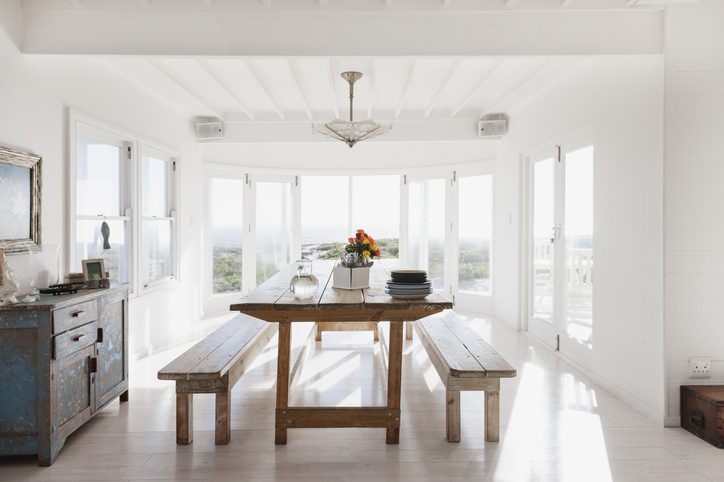
Backless bench seating used for kitchen dining tables were to help hide bulky chairs. These low-profile benches could easily slide underneath the table. They came in style with the farmhouse décor fad. But these benches are uncomfortable, cumbersome to slide onto, and can create an awkward moment of entrapment for whomever finds themselves stuck in the middle. Let's bring back the chairs!
1. Blobs
The “blobby” home trend—also dubbed the “blobject”—has ushered in amoeba-like shapes in décor and furnishings, including curvy tables, wavy mirrors, plump furnishings and mushroom-like lamps. Similarly, a TikTok trend earlier this year unleashed a popular and potentially dangerous DIY project: using spray-foam insulation(link is external) (the toxic industrial foam used by builders) to coat tables, mirrors and home accessories. This globby, gooey gak coated many home accessories, making for foamy, wavy edges. Interior design influencer Phoenix Grey, known as the “Design Daddy,” called this one of the worst home design trends of 2023 and said the result “looks like it’s pulled from the intestines of a horror movie.” We agree! The blobs and spray foam are in stark contrast to the straight edges and clean lines that once dominated interior design. We welcome change, but sometimes a blob is just a blob. And, well, that’s not always pretty.
Posted on
October 26, 2023
by
Marie Taverna
High property prices, elevated interest rates and the rising cost of living has prompted many Canadians to rethink their lifestyle and housing needs. For some, this means pooling financial resources with other family members and friends in order to gain access to the housing market. By co-owning a property (with someone other than their spouse or significant other), homebuyers can not only divide the expense of homeownership among more people, but potentially access larger homes in more desirable locations that they may not have been able to afford on their own.
According to a recent Royal LePage survey1 conducted by Leger, 6% of Canadian homeowners2 co-own their property with another party, not including their spouse or significant other. Of this group, 89% co-own with family members and 7% with friends. Another 8% co-own with someone who is not a friend or family member.
Seventy-six per cent of co-owners say that affordability was a major motivating factor in their decision to co-purchase their property. Not surprisingly, that number rises to 83% for co-owners between the ages of 25 and 34.
“Households group together for many reasons, including communal care for elderly parents, help raising children, cultural preferences or simply to be together. However, the decision to live together, including co-owning a home, is a decision increasingly made for financial reasons,” said Karen Yolevski, COO, Royal LePage Real Estate Services Ltd. “In an environment where home prices and interest rates have risen quickly and sharply, and where the threshold to qualify for a mortgage has become much more challenging, Canadians are pooling their resources and buying homes together. In cases where homebuyers cannot afford to purchase on their own, they are combining their buying power with their parents, children, siblings or even friends.”
Concerning their co-owning situation, 44% of co-owners3 say that they and all fellow co-owners live in the home together. A smaller percentage (28%) say that they co-own a home with another person(s), but they do not cohabitate. Six per cent of respondents say that they co-own a home with another person(s) and neither party uses the home as a primary residence, rather as an investment or recreational property.
According to Stéfanie Cadou, residential real estate broker, Royal LePage Village in Montreal, cohabitation combinations are becoming increasingly diversified these days in order for buyers to gain access to home ownership, which for some means letting go of the option to live in complete solitude, a trend that emerged for many households during the pandemic and has remained permanent for some.
“The decision to buy jointly with family or friends nevertheless requires careful thought and the establishment of clear rules for living together,” said Cadou. “Preparing a cohabitation agreement – ideally notarized – can be beneficial to ensure that rules and obligations are respected by all parties. It is also essential to provide private and common living spaces so that all co-owners can pursue their respective daily routines without encroaching on each other.”
Here are a few highlights from the 2023 Canadian Co-owners Survey:
- Almost one third (32%) of co-owners who were motivated by low affordability purchased their home after the Bank of Canada began raising interest rates in March of 2022
- Nearly two-thirds (65%) of Canadian co-owners say they own a single-family detached property
- 56% of co-owners co-own a home with their parent(s) or parent(s)-in-law; 18% co-own with their adult child(ren)
1An online survey of 501 Canadians 18+, who co-own their home with someone other than their spouse, was completed between August 10, 2023, and August 21, 2023, using Leger’s online panel. No margin of error can be associated with a non-probability sample (i.e., a web panel in this case). For comparative purposes, though, a probability sample of 501 respondents would have a margin of error of ±4.4%, 19 times out of 20. N.B. Participants could co-own with a spouse, but must co-own with someone other than their spouse as well.
2Sample was weighted based on age, gender, and region according to current census data and incidence of home co-ownership was calculated using Q1 and Q2 responses
3In the survey, co-owners are defined as an individual person or a couple who own a property with another person or persons
Posted on
October 26, 2023
by
Marie Taverna
Despite weakened activity, Canadian home prices expected to remain stable for remainder of 2023
While many Canadians have adjusted to the increased cost of borrowing, elevated interest rates continue to impact activity in markets across the country, keeping some buyers and sellers stuck on the sidelines. During the third quarter, inventory rose and sales activity softened, although this did not necessarily translate into steep price declines. Canada’s chronic shortage of housing supply is keeping property prices relatively stable.
“With activity slowing, home prices softened in some of our major markets over the last three months, following a stronger-than-expected second quarter. Prices remain up on a year-over-year basis, with today’s stable market standing in sharp contrast to the steep declines experienced in the third quarter of 2022,” said Phil Soper, president and CEO of Royal LePage. “While trading volumes in most regions remain sluggish, Canada’s housing market is on solid footing, with pent-up demand building. We don’t anticipate a material change in property prices through the remainder of the year.”
Royal LePage is forecasting that the aggregate price of a home in Canada will increase 7.0% in the fourth quarter of 2023, compared to the same quarter last year. The previous forecast (8.5%) has been revised downward to reflect softer activity than expected in the third quarter, which resulted in a modest decline in prices in some markets, including Toronto and Vancouver.
According to the Royal LePage House Price Survey released today, the aggregate1 price of a home in Canada increased 3.6% year over year to $802,900 in the third quarter of 2023. On a quarter-over-quarter basis, however, the national aggregate home price decreased modestly by 0.8%.
“Slower activity has allowed critically low inventory levels to build marginally in many regions, yet the quantity of homes available for sale in this country remains well below the level needed to keep a lid on property price increases,” Soper continued. “Once interest rates begin to ease, even by only a small amount, we expect buyers will return to the market in large numbers and the relentless upward march of home prices will begin again. At its root, housing supply remains out of step with the growing need for it.”
Read Royal LePage’s third quarter release for national and regional insights.
Third quarter press release highlights:
- Aggregate home prices in greater regions of Toronto and Vancouver posted modest quarterly declines in Q3 of 2.8% and 1.8%, respectively. Meanwhile, Greater Montreal Area posted 0.6% aggregate price increase quarter over quarter
- More than half (57%) of regional markets in the report posted a quarter-over-quarter decline in Q3 as activity softened
- Diverging trends among major regions sees year-end forecast downgraded nationally and in the Greater Toronto Area, Edmonton and Regina; forecast maintained in the Greater Montreal Area (GMA), Greater Vancouver, Ottawa, Winnipeg and Halifax; Calgary is the only city whose forecast has been raised
- Royal LePage applauds federal government’s GST rebate policy aimed at incentivizing new construction of purpose-built rental housing
Posted on
October 26, 2023
by
Marie Taverna
Preparing your home for winter can be a daunting task. Starting early and taking time between jobs will make it much more manageable.
Your efforts will keep out the cold, keep money in your pocket through energy savings and keep your home running efficiently.
Here are six ways to winterize your home this season.
Maintain machines and appliances
Having your furnace and ventilation system serviced by a professional in the fall can prevent potential emergency calls when the temperature drops.
For improved air quality throughout your home, have your ducts cleaned annually before the onset of cold weather. Outdoor air conditioning units should be covered properly and their power disconnected during the off-season. While you’re at it, cover any lawn furniture or landscaping that will be exposed to the elements.
Conduct a thorough inspection on your yard tools too – drain fuel from your lawn mower and water from your pressure washer, and complete a maintenance check on your snowblower. This will prolong their lifespan and ensure they work efficiently when you need them. If you heat your home with wood, oil or propane, be sure to top up your supply before the cold months hit.
Seal windows, doors, decks and concrete
If the caulking or weather stripping around your windows and doors is cracked, it can let cold air and moisture in, damaging window sills while causing mildew, mold and significant heat loss. Repair and replace what is necessary and cover older windows with a protective window film until they can be replaced.
Decks, driveways and concrete surfaces are not impermeable. Purchase proper sealants or stains that you can apply yourself before ice and snow arrives, or hire a professional. Preserving the integrity of these large surfaces will only serve you in the long run, saving you from major repairs or full replacements.
Outside water
Before draining your pipes, disconnecting hoses or winterizing your sprinkler system, always turn off the outside water supply. Leaving the outside water on during winter can cause pipes to burst, leading to flooding and damage to your property. If you haven’t already, you may want to consider insulating your water pipes, especially if you leave a summer home unattended off-season or vacation for extended periods of time in the winter months.
Check your gutters
Make sure the gutters are in good condition and properly secured to your home. Prevent damage by clearing out debris to allow snow to melt and drain easily, and point the downspout away from your home. Water should always be moving away from your property to avoid flooding and water damage.
Gutter guards are a worthy investment, as they can help to keep debris and pests out. Clogged gutters can result in leaks that lead to mold and mildew, and act as a breeding ground for mosquitoes and bacteria.
Tend to the attic
Pests can cause damage to your home and your health. Safeguard your attic from birds and rodents who may move in during the winter by checking for access points and placing a screen under any vent. Contact pest control if you suspect an infestation.
To keep warm air from escaping through your roof, determine the R-Value of your current attic insulation and add more to areas not properly insulated, or completely replace the insulation if needed. For added warmth and energy efficiency, you can add insulation to your garage doors and basement.
Inspect your smoke detectors
This important task is not limited to just one season… Inspect your smoke and carbon monoxide detectors monthly, replacing batteries and cleaning them when necessary. Smart home devices can be installed to continuously monitor smoke detectors (and much more), providing added peace of mind.
If some of these tasks are not within your skillset or you simply don’t have the time, hire a general contractor for the small jobs and a certified technician for specialized tasks, such as inspecting the furnace.
Posted on
October 26, 2023
by
Marie Taverna
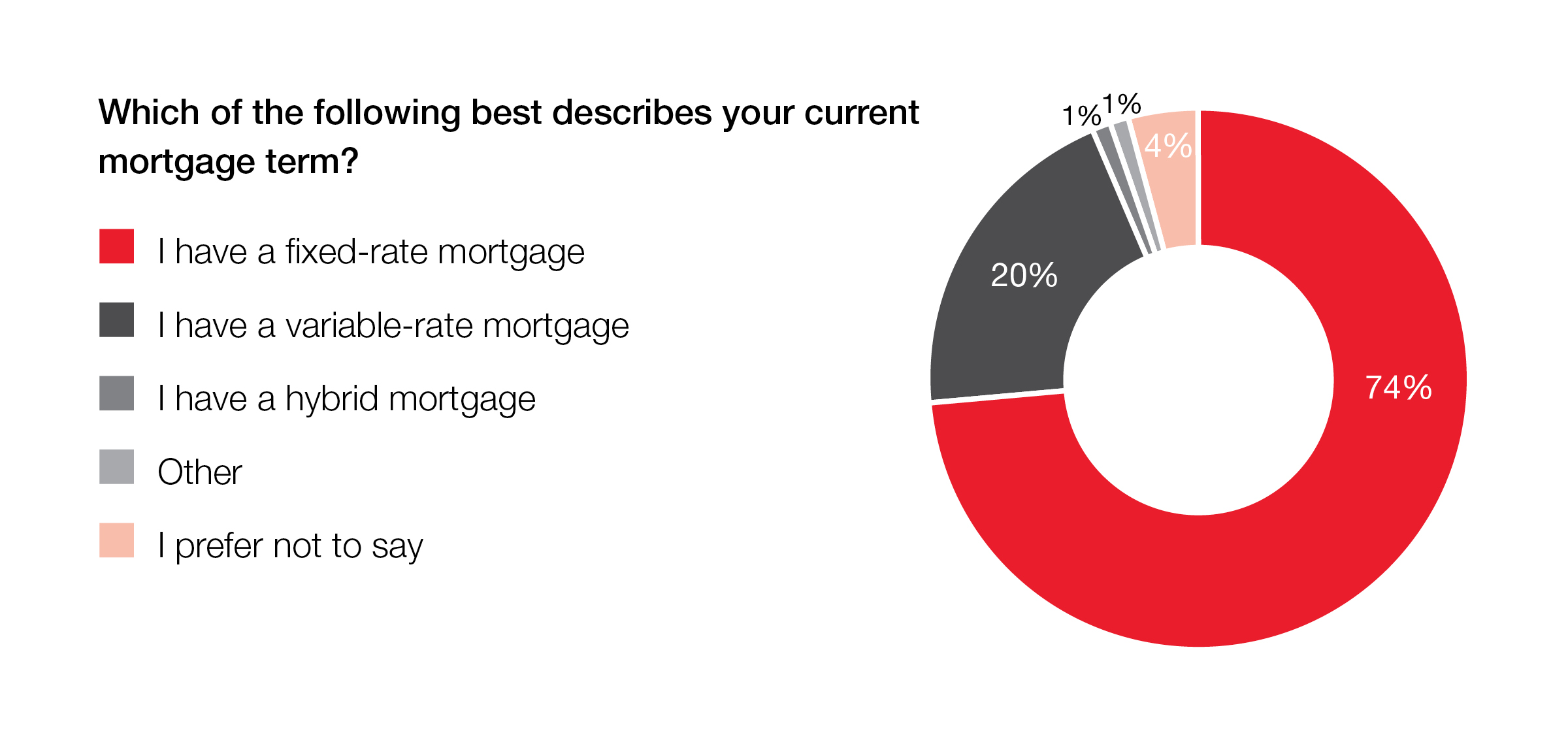
The Bank of Canada announced on October 25th it would be holding its key lending rate at 5.0%, the second consecutive hold since two quarter-point increases were made over the summer. Since March of last year, the central bank has imposed an unprecedented number of rate hikes in an effort to reduce pandemic-fueled inflation, taking interest rates from historic lows to a more than two-decade high. While approximately three quarters (74%) of Canadian mortgage holders currently have a fixed-rate agreement in place, higher interest rates have had a major impact on those with a variable-rate and hybrid mortgage.
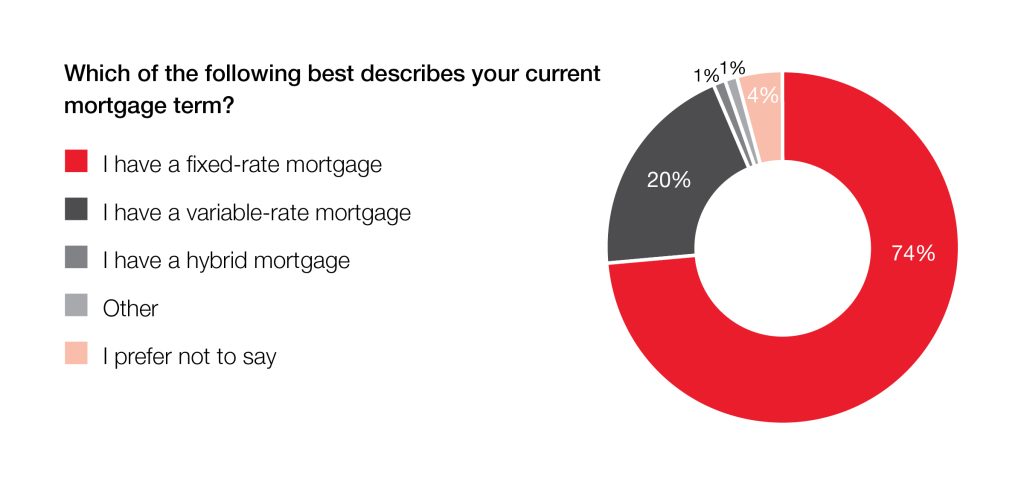
“Some Canadians with variable-rate mortgages have seen their monthly payments double or even triple over the last year and half, due to the Bank of Canada’s aggressive interest rate hike campaign aimed at tamping down high inflation. Those locked in to a fixed-rate mortgage, which most are, have been protected from those increases, at least for a short time,” said Karen Yolevski, chief operating officer, Royal LePage Real Estate Services Ltd. “While the central bank’s key lending rate is expected to come down in the medium term, the likelihood that we will return to rock-bottom rates of less than one per cent is very low. Upon renewal, fixed-rate mortgage holders will be faced with a new reality – higher monthly payments.”
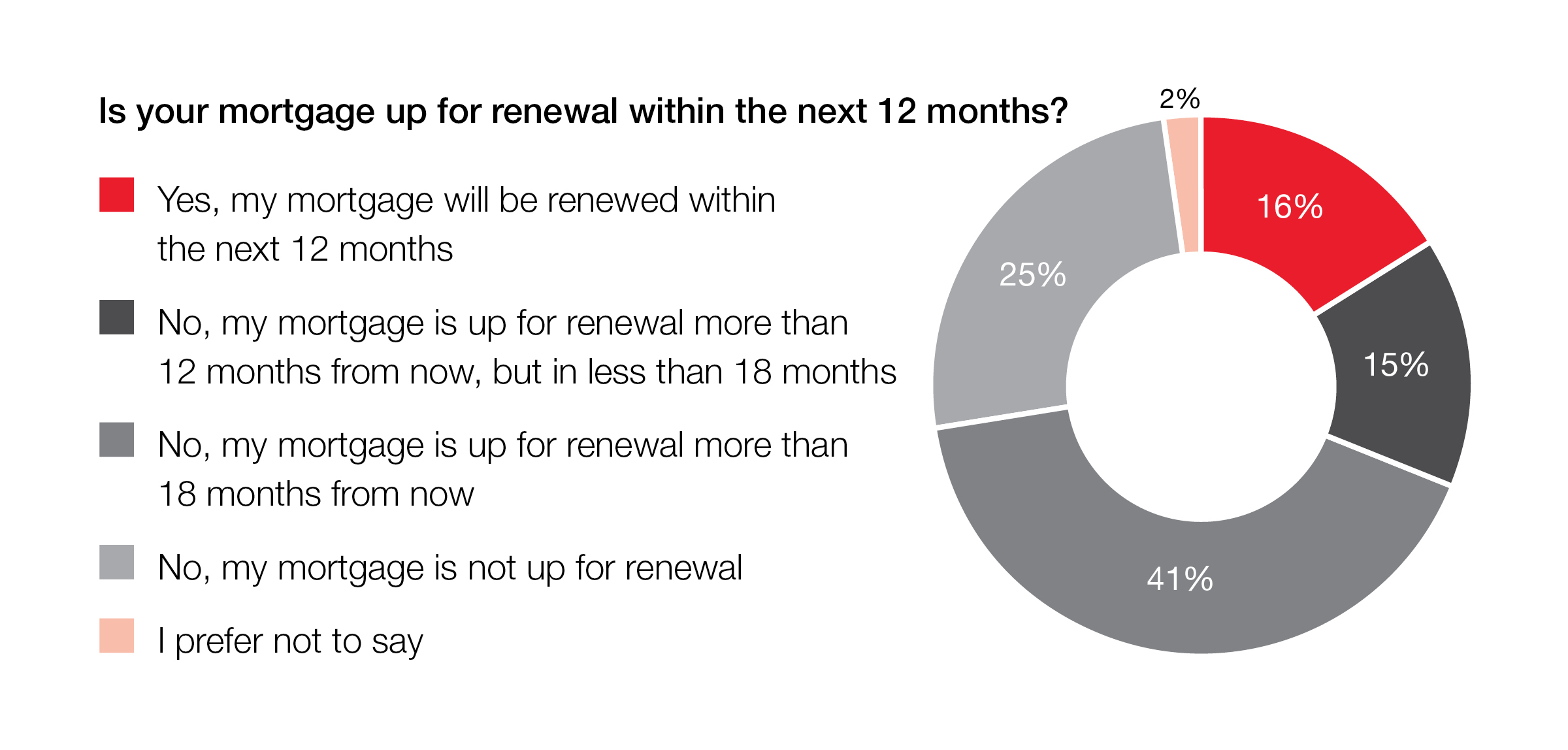
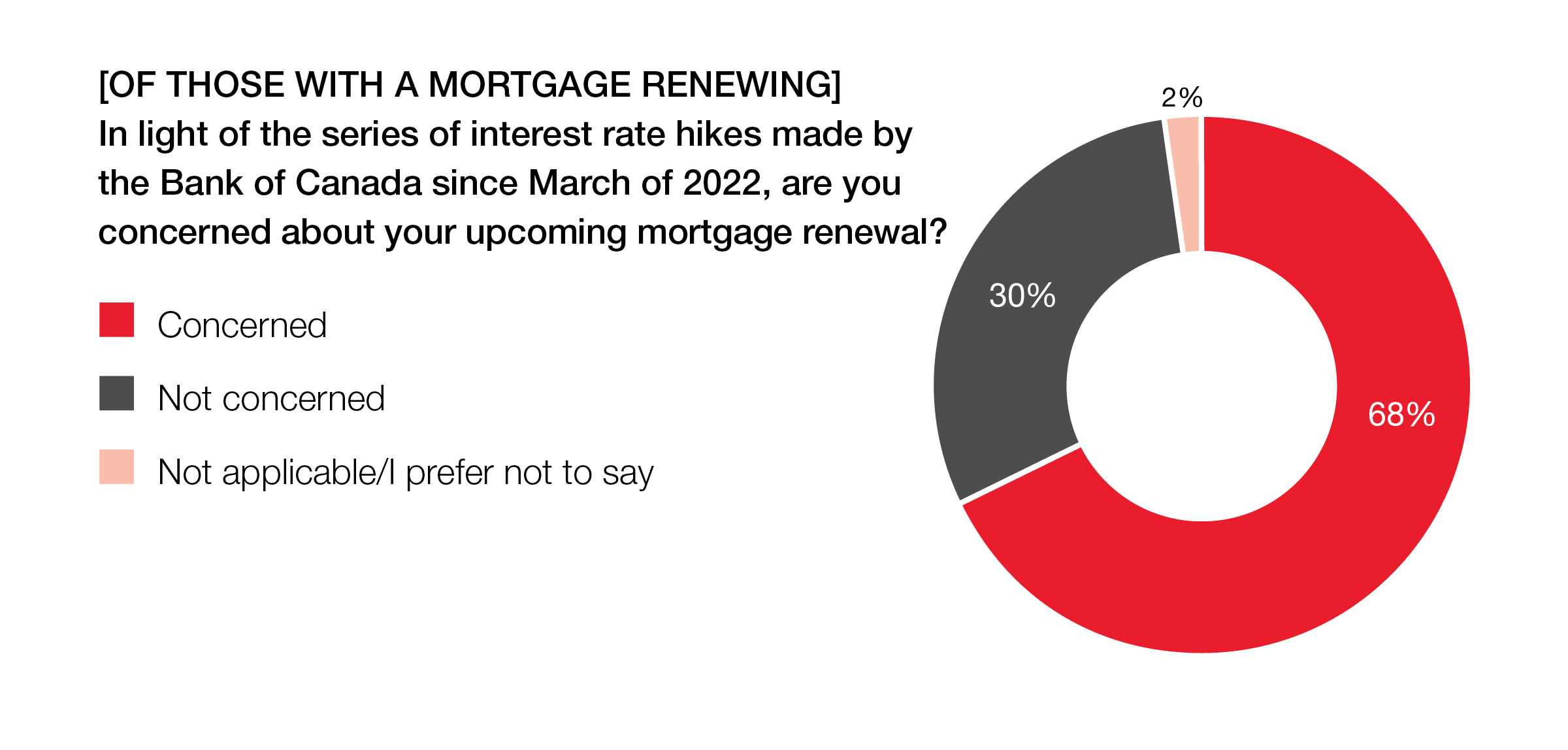
According to a recent Royal LePage survey conducted by Nanos,1 74% of Canadians with a residential mortgage set to renew within the next 18 months say they are concerned about the renewal, in light of the series of interest rate hikes made by the Bank of Canada since March of 2022. 31% per cent of all mortgagees in Canada say their lending agreement is set to renew within the next year and a half (16% within 12 months and 15% in 12-18 months). That’s approximately 3.4 million people with a mortgage that is set to renew by March of 2025.2
Of those who have a variable-rate or hybrid mortgage, 64% say that higher interest rates have caused their mortgage payment to hit its trigger rate – when the mortgage payment no longer covers the interest portion – and have subsequently caused their monthly payments to increase.
“There is no doubt that Canadians’ financial stability has been put to the test over the last few years. In addition to home prices skyrocketing in 2021 and the start of 2022 – followed by interest rate increases that have caused monthly mortgage payments to rise by hundreds, if not thousands, of dollars – the cost of everyday essentials like food and fuel have also surged,” said Yolevski. “Canada’s strong employment rate and the rigorous lending practices of our major banks continue to ensure that a vast majority of households are able to navigate these financial challenges without having to sell their homes.”
For more insights, read the full press release and review the national data chart linked below.
1Nanos conducted an online representative non-probability panel survey of 2,004 Canadians, including 933 current residential mortgage holders between the ages of 27 to 75, from September 8th to 14th, 2023. The sample is geographically stratified to be representative of Canada. No margin of error applies to this research.
2Based on Statistics Canada. Table 17-10-0005-01 Population estimates on July 1st, by age and sex for Canadians aged 26-74 in 2022 and survey results indicating 45% of respondents currently hold a residential mortgage.
Posted on
October 11, 2023
by
Marie Taverna
When renovating a home, the major concerns are often making the space more functional, stylish, and cozy. But when you have a pet, or are planning to get one, some of those design considerations may change to best suit your four-legged family member’s needs.
Here are a few tips to help make your home more pet-friendly:
Avoid carpet flooring
Carpets can gather dirt and stains like no other. Many pets shed, and some may feel the occasional need to relieve themselves in the wrong place. Plus, animals can easily tip over glasses and plates with their tails while exploring tabletops. Avoid a time-consuming and potentially expensive clean-up, and opt for durable and easy-to-clean flooring like laminate, vinyl, stone, or ceramic.
Get washable, wipeable furnishings
When it comes to your couch and other furniture, choose fabrics and textures that are less of a magnet for pet fur and, if necessary, are somewhat claw-resistant. Consider certain types of synthetic fibres that can be more resistant to damage. You may also want to apply a protective layer of wipeable paint… just in case you end up with paw prints on your walls.
Design a ‘pet pad’
As a way to minimize mess and not give the impression that you have a Tasmanian devil for a pet, consider setting up a designated play area for your furry friend. Retrofit a small portion of your home with a comfy bed, bowls for food and water, a storage bin for toys, and scratch pads. If they feel like they have their own space, it may keep your pets from spreading toys around the house and taking things from other rooms. This can also help contain any potential messes to one area of your home… preferably one that has durable floors.
Safety-proof your yard
Outside of the home, plant only pet-friendly flowers and plants in your garden, avoiding toxic vegetation like tulips, lilies and certain kinds of mulch. Provide your pet with an outdoor shelter and some shade for hot summer days. Ensure you build a sturdy fence around the yard to help keep them from running away. This should also prevent skunks, raccoons and other critters – including your neighbours’ pets – from setting up shop on your property and harming or disturbing your furry friend.
Posted on
October 11, 2023
by
Marie Taverna
The season of pumpkin spice is once again upon us, and so are fall decorating traditions. For many of us, the transition from summer to fall is a nostalgic time to break out the spooky decor, unpack the turkey-themed table runner and adorn the front door with our favourite fall wreath. But, if dressing up the house with orange pumpkins and burlap year after year is getting a bit stale over time, there’s no harm in shaking up your fall decorating choices this season.
Here are four new 2023 fall decor trends you can try in your home (sans pumpkins):
Earthy tones
Fall colours are traditionally defined by shades of orange, red and brown. This year, more earth-like tones are making their way into home, including varieties of sage green, warm beige and caramel, rustic brick red and earthy terracotta. You can achieve this softer, more muted fall look through coloured glassware, cushion covers, ceramics, blankets and other housewares that are easy to swap out when the seasons change. If you’re looking to add a contrasting statement piece to your interior this fall, try introducing an eye-catching accent colour with a hint of black, indigo or copper.
Rustic touches
Rustic furniture is a staple in fall design this year. Building off of the theme of warm and earth-inspired interiors, distressed or vintage finds will bring a touch of charm to your home this season. The most economical and environmentally-friendly way to pull off this look is with the help of your local thrift store or online marketplaces, where you’re likely to find an array of second-hand furniture, rugs and trinkets. You don’t need to spend a lot to add a ton of character to your space.
Layered textures
As the temperature drops, we tend to layer up with different fabrics to keep our bodies warm – it’s no different for our homes.
This fall, mix and match different layers of textures and fabrics for an extra cozy feel. Whether it’s your bedding, accent cushions or rugs, get creative with different textiles, such as wool, knit, velvet, satin and cashmere. If your interior tastes are more neutral, you can still achieve this trend with a monochromatic colour palette to elevate your home.
Fruits and flowers
Move aside pumpkins – fruits are all the rage this year. Instead of opting for your typical array of white and orange gourds, fruits are taking centre stage in 2023. Seasonal fruits, such as apples, figs and pears, can be repurposed as place cards or arranged in bowls for a less expected fall centrepiece. Alternatively, you can showcase fruits through decorative flatware and table textiles, such as fabric napkins. If fruits aren’t really your thing, opt for dried florals instead like pampas grass, sunflowers or wheat stalks to add a touch of ‘Cottage Core’ to your living space.
Bonus tip: Give attention to outdoor spaces
Mild weather is known to last into mid-October in some parts of the country, meaning we can use our beloved outdoor spaces for longer periods of time. Show your balcony, patio or backyard some fall decor love too by dressing it up with lanterns, wreaths and seasonal flowers, such as chrysanthemums or hydrangeas. Add a touch of coziness around your outdoor fireplace or sitting area with water-resistant pillows and blankets in your favourite fall colours and patterns.
|
 Subscribe with RSS Reader













 The data relating to real estate on this website comes in part from the MLS® Reciprocity program of either the Greater Vancouver REALTORS® (GVR), the Fraser Valley Real Estate Board (FVREB) or the Chilliwack and District Real Estate Board (CADREB). Real estate listings held by participating real estate firms are marked with the MLS® logo and detailed information about the listing includes the name of the listing agent. This representation is based in whole or part on data generated by either the GVR, the FVREB or the CADREB which assumes no responsibility for its accuracy. The materials contained on this page may not be reproduced without the express written consent of either the GVR, the FVREB or the CADREB.